
Beyond Pilots: Strategic Discovery as the Foundation for Scaling Banking Automation
Abstract
The Discovery Deficit: Why 75% of Banks Can’t Scale Beyond Pilots
The gap between automation potential and automation adoption in banking is not primarily a technology problem; it is a discovery problem. Despite widespread investment in RPA platforms, intelligent document processing, and process mining tools, three-quarters of financial institutions remain confined to tactical, piecemeal implementations. The State of RPA in Financial Institutions 2024 revealed that 75% of institutions were adopting automation in a fragmented fashion, while only 25% had embraced a strategic, enterprise-wide approach.
This pattern persists not because banks lack capable technology or skilled practitioners, but because traditional discovery methodologies produce business cases that fail to secure executive sponsorship for scaled deployment. The problem lies in what gets measured, and more importantly, what gets valued during the process assessment phase.
The Traditional Discovery Trap
Conventional process discovery focuses on operational metrics: task duration, transaction volume, error rates, and full-time equivalent (FTE) calculations. A typical discovery output might conclude: "Process X requires 47 manual steps, consumes 2.3 FTE annually, and has a 12% error rate. Automation will reduce processing time by 70% and eliminate 1.8 FTE."
On the surface, this appears compelling. The efficiency gains are quantifiable. The ROI is straightforward. Yet when presented to executive leadership or Change Advisory Boards, these business cases frequently encounter resistance:
- CFOs question opportunity cost: "Is eliminating 1.8 FTE the best use of our digital transformation budget compared to mobile banking enhancements or cloud infrastructure modernization?"
- Chief Risk Officers ask about strategic value: "Does this reduce our regulatory exposure or merely shift where manual review occurs?"
- Chief Digital Officers challenge scalability: "We have 200 processes that could save 1-2 FTE each. Should we automate all of them? How do we prioritize?"
- Chief Human Resources Officers raise workforce concerns: "What happens to displaced staff? How does this align with our talent development strategy?"
Traditional discovery delivers tactical insights but cannot answer strategic questions. It positions automation as a cost-cutting exercise rather than a value-creation capability, making it difficult for executives to distinguish between automating for efficiency versus automating for competitive advantage.
Why Efficiency-Focused Discovery Limits Executive Sponsorship
The language of traditional discovery of FTE reduction, time savings, and throughput improvement resonates with operational managers but fails to engage executive decision-makers who allocate capital across competing strategic priorities. This creates several critical barriers to scaled adoption which include narrow value definition, short-term optimization bias, portfolio blindness, and defensive positioning. By focusing exclusively on direct cost savings, traditional discovery ignores the strategic intangibles that executives increasingly prioritize related to regulatory agility, competitive positioning, workforce enablement, and brand protection. A compliance automation initiative might save 2 FTE. Still, it could also reduce audit findings by 40%, accelerate regulatory change implementation by six months, and mitigate reputational risk, which are not included in the efficiency-focused business case.
ROI calculations based on annual cost savings favor quick wins over transformational initiatives. A three-month payback period looks attractive in isolation; however, executives evaluating a five-year digital transformation roadmap need to understand multi-year value creation, compounding benefits, and strategic option value.
Traditional discovery evaluates processes in isolation, providing no framework for enterprise-level prioritization. Executives cannot compare the strategic value of automating mortgage processing versus wealth management onboarding versus regulatory reporting using efficiency metrics alone. This results in ad-hoc project approval rather than intentional portfolio management.
When automation business cases emphasize FTE elimination, they trigger workforce concerns and cultural resistance. Executives must navigate organizational anxiety and talent retention challenges. Discovery that frames automation as workforce augmentation rather than replacement creates a fundamentally different conversation.
The Executive Void
The consequence of efficiency-focused discovery is predictable: automation initiatives receive approval but remain underfunded, understaffed, and relegated to departmental pilots. Without executive sponsorship, automation teams lack the authority to drive enterprise architecture decisions, the budget to invest in governance infrastructure, and the political capital to overcome organizational resistance.
This is why 75% of banks are trapped in tactical mode. It is not because they lack vision or technical capability; instead, traditional discovery produces business cases that cannot compete for executive attention and capital allocation. The path from tactical pilots to strategic transformation requires a fundamental shift in how value is discovered, quantified, and communicated.
That shift begins with expanding discovery to include strategic impact assessment, specifically, benefit-cost ratio analysis that captures the full spectrum of value delivered by modern automation technologies.
From Tactical to Strategic Discovery
Business process discovery has evolved significantly over the past two decades, yet most financial institutions remain anchored to methodologies designed for an era of simple task automation. Understanding this evolution and recognizing where process evaluation enhancements are essential for institutions seeking to scale automation beyond tactical deployments.
The Evolution of Discovery Methodologies
First Generation: Task Mining and Time-Motion Studies
Early automation discovery borrowed heavily from industrial engineering and Six Sigma practices. Practitioners shadowed employees, documented keystrokes, measured task duration, and mapped process flows. The output was granular and operational: "Step 12 takes 4.2 minutes on average. Step 18 has a 15% error rate." This approach served its purpose for early RPA deployments targeting high-volume, repetitive tasks, but it treated processes as isolated production lines rather than components of an interconnected enterprise system.
Second Generation: Process Mining and Analytics
As automation technologies matured, discovery methodologies incorporated digital footprint analysis. Process mining tools extracted event logs from enterprise systems, reconstructing actual process execution rather than relying on manual observation. This provided unprecedented visibility into process variants, bottlenecks, and compliance deviations. Yet the analysis remained primarily descriptive and efficiency-oriented. The question being answered was: "How does this process actually work, and where are the inefficiencies?" Strategic considerations—why this process matters, what capabilities it enables, how it connects to competitive positioning—remained outside the scope.
Third Generation: Strategic Impact Assessment
Advanced financial institutions are now moving toward a third generation of discovery that integrates operational analysis with strategic evaluation. This approach recognizes that automation decisions are capital allocation decisions, requiring the same rigor applied to branch expansion, technology platform selection, or merger integration. Strategic discovery asks fundamentally different questions:
- What enterprise capabilities does this process enable?
- How does automation of this process affect our competitive position?
- What strategic risks are mitigated or introduced?
- What compounding value accumulates over multi-year horizons?
- How does this investment compare to alternative uses of capital?
These questions cannot be answered with task-level metrics. They require a framework that captures both tangible and intangible value, accounts for time-adjusted benefits and costs, and enables portfolio-level prioritization. This is where benefit-cost ratio analysis becomes essential.
Why BCR Belongs in Discovery, Not Just Evaluation
Most organizations treat benefit-cost ratio as an evaluation tool applied after discovery is complete and technical design is underway. This is a strategic error. BCR analysis should be integrated into discovery itself, fundamentally shaping which processes are selected for automation and how business cases are framed.
BCR as a Discovery Lens
When BCR analysis is applied during discovery, it forces practitioners to look beyond operational metrics and investigate strategic context:
- Benefit Identification: Discovery teams must engage with stakeholders across compliance, risk, customer experience, and strategy to identify the full spectrum of value. This surfaces considerations that pure efficiency analysis misses: regulatory resilience, audit readiness, workforce enablement, competitive differentiation, and brand protection.
- Cost Reality: BCR discovery requires honest accounting of total lifecycle costs, including often-overlooked elements like governance infrastructure, model monitoring, change management, and technical debt remediation. This prevents the optimistic cost assumptions that plague traditional ROI calculations.
- Time Horizon Alignment: By incorporating present value analysis during discovery, teams align automation planning with enterprise capital planning cycles. A project with modest first-year returns but strong multi-year value creation can be positioned appropriately rather than dismissed for failing to meet arbitrary payback period thresholds.
- Strategic Prioritization: BCR provides a common denominator for comparing disparate automation opportunities. Should the bank automate mortgage document validation (high complexity, strategic risk mitigation) or check processing (high volume, operational efficiency)? BCR analysis during discovery enables evidence-based prioritization rather than political decision-making.
The Discovery Conversation Shift
Consider how BCR-enhanced discovery changes stakeholder dialogue:
Traditional Discovery Conversation: "We've identified an opportunity to automate closing disclosure review. Current state requires 5 FTE spending 50% of their time on manual validation. Automation will save $200,000 annually in labor costs with an 18-month payback period."
BCR-Enhanced Discovery Conversation: "We've assessed the strategic impact of automating closing disclosure review. Present value analysis over a three-year horizon shows a BCR of 3.10, generating $2.36 million in value. Beyond the direct labor efficiency, this automation delivers regulatory resilience by ensuring consistent TRID compliance, reduces audit findings that have cost us an average of $150,000 annually, accelerates loan approvals by 2-3 days enabling faster time-to-revenue, and creates reusable capabilities for other document-intensive processes. The initial investment of $500,000 plus $100,000 in annual governance costs positions us to scale this capability across consumer lending and deposit operations."
The second conversation speaks the language of executive decision-making. It positions automation as strategic investment rather than cost reduction. It provides the context necessary for capital allocation and portfolio prioritization. Most importantly, it creates the foundation for executive sponsorship.
From Discovery to Adoption: The Critical Link
The connection between discovery methodology and adoption velocity is direct and measurable. Organizations that expand discovery to include BCR analysis produce business cases that:
- Compete effectively for capital allocation against other strategic initiatives
- Secure executive sponsorship by demonstrating alignment with institutional priorities
- Navigate workforce concerns by emphasizing augmentation and upskilling
- Enable portfolio management by providing comparable value metrics
- Build momentum through demonstrated strategic impact
This mechanism enables institutions to break free from tactical, piecemeal automation. Strategic discovery creates strategic business cases, securing strategic investment, enabling strategic deployment, and generating strategic value. This cycle drives enterprise-wide transformation.
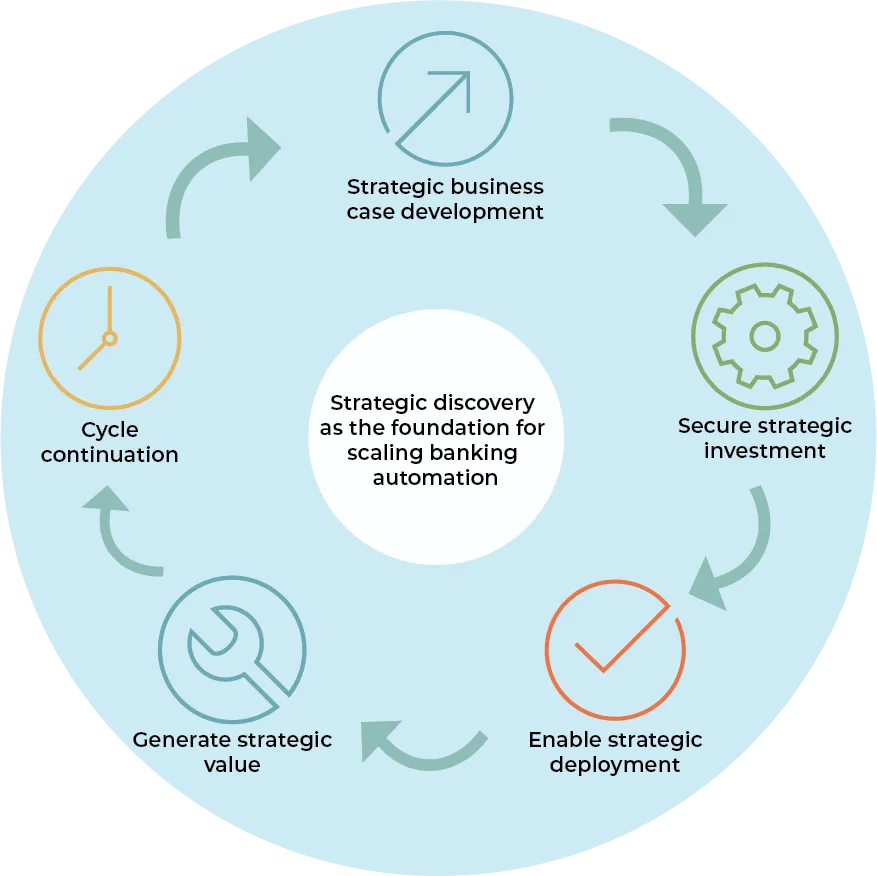
The question is not whether to expand discovery beyond efficiency metrics, but how quickly institutions can make this transition before competitors establish insurmountable advantages.
Section 3: Benefit-Cost Ratio: The Strategic Discovery Framework
Benefit-Cost Ratio analysis represents a fundamental shift in how financial institutions assess automation opportunities—moving from operational efficiency measurement to strategic investment evaluation. When integrated into the discovery process, BCR provides the analytical foundation and executive communication framework necessary to scale automation from tactical pilots to enterprise transformation.
Understanding BCR in the Context of Automation Discovery
At its core, BCR compares the present value of all benefits generated by an automation initiative to the present value of all costs incurred over a defined time horizon. The formula is simple:
BCR = Present Value of Benefits ÷ Present Value of Costs
A BCR greater than 1.0 indicates that benefits exceed costs. A BCR of 3.0 means that for every dollar invested, the institution expects to receive three dollars in present-value returns. However, the true power of BCR in discovery is not the final ratio, but in the comprehensive value identification and strategic framing required to calculate it.
What BCR Captures That Traditional ROI Misses
Traditional ROI calculations focus on first-year cost savings divided by implementation costs, creating a narrow, short-term view of value. BCR analysis forces discovery teams to investigate and quantify a broader spectrum of impact:
Multi-Year Value Creation: By discounting future benefits and costs to present value, BCR accounts for sustained value generation over time. An automation initiative that delivers consistent benefits for five years is fundamentally more valuable than one with identical first-year returns but declining impact, yet traditional ROI treats them identically.
Strategic Intangibles: BCR methodology provides a framework for quantifying benefits that efficiency metrics ignore, such as regulatory compliance improvements, reduced audit findings, accelerated product launches, workforce retention, competitive positioning, and brand protection. While some degree of estimation is required, the discipline of quantification forces rigorous evaluation of strategic claims.
Total Lifecycle Costs: BCR requires accounting for ongoing costs, including maintenance, governance, model retraining, and technical debt management. This prevents the optimistic cost assumptions common in traditional business cases where implementation costs dominate, and operational costs are understated or ignored entirely.
Time Value of Money: Present value discounting aligns automation investment evaluation with how CFOs and capital allocation committees assess all strategic investments—using the institution's weighted average cost of capital as the discount rate. This enables direct comparison between automation initiatives and alternative investments like branch modernization, cloud migration, or digital platform development.
The BCR Discovery Process
Integrating BCR into automation discovery requires expanding stakeholder engagement and deepening the analysis performed during the assessment phase:Phase 1: Comprehensive Benefit Identification
Discovery teams must engage with stakeholders across multiple functions to surface the full value spectrum:
Financial and Operational Benefits:
- Direct labor cost savings from reduced manual processing
- Productivity gains from reallocating workforce to higher-value activities
- Error reduction savings from improved accuracy and consistency
- Reduced operational risk costs (overdrafts, payment delays, penalties)
- Accelerated revenue recognition from faster cycle times
Strategic and Intangible Benefits:
- Regulatory compliance improvements and reduced audit findings
- Risk mitigation (reduced exposure to fraud, errors, or compliance violations)
- Enhanced customer experience (faster response times, personalized service)
- Workforce enablement (reduced burnout, improved retention, upskilling opportunities)
- Competitive positioning (faster time-to-market, service differentiation)
- Brand and reputational protection (consistent execution, transparent decision-making)
Capability Creation:
- Reusable automation components applicable to adjacent processes
- Data infrastructure and analytics capabilities generated as byproducts
- Organizational learning and automation maturity advancement
Phase 2: Rigorous Cost Assessment
Comprehensive cost identification ensures BCR analysis reflects true investment requirements:
Implementation and Technology:
- Software licensing or SaaS subscription fees
- Infrastructure requirements (compute, storage, networking)
- Integration with legacy systems and middleware development
- Security and compliance tooling
Human Capital:
- Development and configuration labor (internal and external)
- Business analysis and process redesign
- Training and change management
- Ongoing support and maintenance staffing
Governance and Risk Management:
- Model monitoring and performance management systems
- Compliance and audit readiness infrastructure
- Ethical review frameworks and explainability tooling
- Technical debt remediation
Phase 3: Time Horizon and Discount Rate Selection
Strategic discovery requires explicit time horizon decisions:
Time Horizon: Most banking automation initiatives use 3-5 year evaluation periods, aligning with strategic planning cycles and technology refresh cadences. Shorter horizons (1-2 years) may be appropriate for tactical deployments with limited strategic value. Longer horizons (7-10 years) may be justified for foundational infrastructure investments.
Discount Rate: The appropriate discount rate reflects the institution's weighted average cost of capital (WACC), typically ranging from 6-10% for mid-sized banks. This rate should be consistent across automation business cases to enable portfolio-level comparison.
How BCR Changes the Executive Conversation
BCR-enhanced discovery transforms business cases from operational proposals to strategic investment memoranda. Consider the framing differences:
Efficiency-Focused Business Case: "We propose automating account reconciliation to reduce manual processing time by 65% and eliminate 3.2 FTE. Implementation cost is $280,000 with expected annual savings of $220,000, yielding a 15-month payback period and five-year ROI of 293%."
BCR-Enhanced Strategic Business Case: "We recommend prioritizing automated reconciliation as a strategic investment with a BCR of 2.8 over a four-year horizon. This initiative generates $1.8 million in present-value benefits against $640,000 in lifecycle costs. Value drivers include $220,000 in annual labor efficiency, $85,000 in error reduction and rework avoidance, $120,000 in audit and compliance improvements, $60,000 in accelerated exception resolution, and strategic capability creation enabling expansion to 12 adjacent reconciliation processes. The initiative aligns with our regulatory resilience and operational excellence strategic pillars while positioning us to scale automation across enterprise finance operations."
The second approach provides executives with the context and strategic framing necessary to make informed capital allocation decisions. It speaks their language. It addresses their concerns. It positions automation as value creation rather than cost-cutting.
BCR as a Portfolio Management Tool
When consistently applied across automation opportunities, BCR enables sophisticated portfolio management:
- Prioritization: Rank initiatives by BCR to identify the highest-value opportunities
- Risk Adjustment: Evaluate BCR sensitivity to assumption changes, identifying robust versus fragile business cases
- Resource Allocation: Distribute budget and talent based on strategic value rather than political influence
- Performance Tracking: Monitor actual BCR realization against projections, building institutional estimation capability
This portfolio perspective is essential for organizations seeking to move from tactical automation to enterprise-wide transformation. Individual projects may have compelling efficiency gains, but strategic impact is what secures executive sponsorship and sustained investment.
The Discovery Imperative
Expanding discovery to include BCR analysis requires additional effort, more stakeholder engagement, deeper analysis, and more sophisticated financial modeling. Yet this investment in discovery rigor pays exponential dividends in business case strength, executive sponsorship, and ultimately, adoption velocity.
Financial institutions that integrate BCR into their discovery methodology create a sustainable competitive advantage: they can identify and articulate strategic value that competitors miss, secure capital allocation that competitors cannot justify, and scale automation capabilities that competitors struggle to deploy.
In an industry where digital transformation is no longer optional, BCR-enhanced discovery is the mechanism by which leading institutions pull ahead.
Section 4: The Executive Persuasion Framework
Securing executive sponsorship for enterprise-wide automation requires more than demonstrating positive ROI or technical feasibility. Executives operate in the context of constrained capital, competing strategic priorities, regulatory scrutiny, and stakeholder accountability. To earn their sustained commitment, automation business cases must address the specific questions and concerns that shape C-suite decision-making.
BCR-enhanced discovery provides the analytical foundation for executive persuasion by reframing automation from an operational efficiency initiative to a strategic investment. However, the business case presentation must explicitly connect BCR findings to executive priorities and decision frameworks.
What Executives Need to Approve Scaled Automation Investment
Portfolio Thinking, Not Project Thinking
Executives do not evaluate automation initiatives in isolation. They assess them within a portfolio of competing investments, including cloud infrastructure modernization, branch network optimization, digital banking platform enhancement, cybersecurity hardening, regulatory compliance infrastructure, and numerous other capital demands.
The question is never simply, "Should we automate process X?" The question is always "Given limited capital and implementation capacity, should we prioritize automating process X over alternatives Y and Z?" BCR-enhanced discovery enables this portfolio-level comparison by providing a standard value metric across disparate initiatives. An automation project with a BCR of 3.2 can be directly compared to a cloud migration with a BCR of 2.8 or a branch consolidation with a BCR of 2.4. This allows capital allocation committees to make evidence-based prioritization decisions rather than relying on political influence or historical spending patterns.
When presenting automation business cases to executives, explicitly position the proposal within the strategic investment portfolio: "Among digital transformation initiatives under consideration this fiscal year, automated mortgage document validation ranks in the top quartile by BCR, generating higher strategic value per dollar invested than five of the seven projects currently in planning."
Strategic Alignment, Not Just Financial Returns
Every financial institution articulates strategic priorities: customer experience excellence, operational resilience, regulatory leadership, workforce development, environmental stewardship, and community investment. Executives are accountable to boards of directors, regulators, investors, and customers for advancing these priorities.
Automation business cases that demonstrate clear alignment with institutional strategy are fundamentally more compelling than those justified by efficiency gains alone. BCR analysis provides the framework to quantify this alignment:
- If customer experience is a strategic priority, quantify how automation reduces response times, personalizes interactions, or eliminates friction points
- If regulatory resilience is a strategic pillar, measure reduced audit findings, faster regulatory change implementation, or improved transparency
- If workforce development is emphasized, calculate retention improvements, upskilling opportunities, or reduced burnout
The most powerful automation business cases explicitly map BCR components to strategic priorities: "This initiative directly advances three of our five strategic pillars: operational excellence through 40% efficiency gains, regulatory leadership through consistent TRID compliance, and workforce empowerment through elimination of repetitive manual tasks and redeployment to customer consultation roles."
Risk-Adjusted Returns and Downside Protection
CFOs and Chief Risk Officers evaluate investments not only by expected returns but also by downside risk and optionality. BCR-enhanced discovery should address these concerns explicitly:
Sensitivity Analysis: How does BCR change if benefits are 20% lower than projected or costs are 30% higher? If BCR remains above 2.0 even under conservative assumptions, the business case is robust. If BCR drops below 1.0 with modest assumption changes, the proposal is fragile and may warrant additional risk mitigation or prioritization behind more stable opportunities.
Reversibility: What is the exit cost if the automation initiative fails or technology assumptions prove incorrect? Initiatives with low sunk costs and reusable components have embedded option value that traditional financial analysis overlooks.
Opportunity Cost of Inaction: What happens if we do not automate this process? BCR analysis should quantify the cost of the status quo: continued error rates, regulatory exposure, competitive disadvantage, and workforce attrition. Often, the business case is not "invest $500,000 to generate $1.5 million in benefits" but rather "invest $500,000 to generate $1.5 million in benefits OR accept $800,000 in ongoing costs and strategic risks by maintaining the status quo."
Competitive Positioning and Strategic Imperative
Executives increasingly recognize that digital transformation is not discretionary. Fintechs and digital-native competitors are redefining customer expectations and operational benchmarks. For traditional banks, the relevant question is not "Should we invest in automation?" but rather "How quickly can we deploy automation at scale before we lose irretrievable competitive ground?"
Effective business cases position automation within this competitive context: "Our peer analysis shows that regional banks with assets between $5 billion and $20 billion have achieved an average automation penetration rate of 35% across consumer lending operations. We currently stand at 12%. This gap translates to a competitive disadvantage in loan processing speed (7.2 days versus their 4.8 days) and cost-to-originate ($1,840 versus their $1,320). Closing this automation gap through the proposed initiative represents not just efficiency improvement but competitive necessity."
Why Traditional ROI-Based Discovery Fails Executive Scrutiny
Despite years of automation investment, many financial institutions struggle to secure executive sponsorship for scaled deployment. Understanding why efficiency-focused business cases fail at the C-suite level reveals why BCR-enhanced discovery is essential:
The FTE Reduction Problem
Traditional business cases emphasize full-time equivalent elimination as the primary value driver. This framing creates multiple problems for executives:
- Workforce Sensitivity: FTE reduction triggers concerns about layoffs, talent retention, union relations, and community reputation. Executives must balance operational efficiency with broader stakeholder responsibilities.
- Displacement Uncertainty: What happens to displaced employees? Retraining costs, severance obligations, and organizational disruption are often understated in efficiency-focused business cases.
- Limited Strategic Value: Eliminating 2-3 FTE from a back-office process may improve departmental efficiency, but rarely moves enterprise-level strategic metrics that executives are accountable for delivering.
BCR analysis reframes the conversation by quantifying workforce augmentation value: reduced burnout, improved retention, upskilling opportunities, and reallocation to higher-value activities. The business case becomes "enabling our people to deliver more strategic value" rather than "eliminating our people to reduce costs."
The Single-Year Myopia Problem
ROI calculations based on annual cost savings create short-term optimization bias. A project with a 12-month payback period may look attractive in isolation, but it may deliver limited long-term strategic value. Conversely, initiatives with modest first-year returns but compounding multi-year benefits are systematically undervalued.
Executives managing five-year strategic plans need to understand multi-year value creation. BCR's present value framework aligns automation investment evaluation with strategic planning horizons, enabling executives to identify initiatives that create sustained competitive advantage rather than temporary efficiency gains.
The Problem with Overlooking Intangible Benefits
Traditional ROI calculations ignore strategic intangibles: regulatory resilience, brand protection, competitive positioning, and workforce enablement. Yet these are increasingly the factors that differentiate successful institutions from struggling ones.
When a compliance automation initiative prevents a regulatory consent order, the value extends beyond the labor savings from reduced manual review. The value includes avoided penalties ($5 to $20 million), preserved reputation (customer retention and brand value), maintained market access (avoiding business restrictions), and executive peace of mind (reduced personal liability and career risk).
BCR methodology provides the framework to quantify these intangibles, ensuring business cases reflect the full strategic value delivered by automation.
The Comparison Impossibility Problem
Without a common value metric, executives cannot make informed portfolio decisions. How do you compare automating mortgage processing (high complexity, strategic risk reduction) versus check processing (high volume, operational efficiency) versus wealth management onboarding (customer experience improvement)?
Traditional metrics, such as processing time reduction, error rate improvement, and FTE savings, cannot be meaningfully compared across diverse process types. BCR provides the common denominator that enables evidence-based prioritization. Both projects can be evaluated by dollars of strategic value generated per dollar invested, allowing direct comparison despite fundamentally different operational characteristics.
Building the Executive Business Case: A Practical Framework
When presenting BCR-enhanced discovery findings to executives, structure the business case to address their specific decision criteria:
1. Strategic Context
- Which institutional strategic priorities does this initiative advance?
- What competitive pressures or regulatory requirements create urgency?
- How does this initiative position us for future capability development?
2. Value Proposition
- BCR magnitude and time horizon
- Breakdown of benefit categories (operational, strategic, intangible)
- Comparison to alternative investment opportunities
3. Risk and Sensitivity
- BCR under conservative assumptions
- Key assumption dependencies and mitigation strategies
- Downside protection and exit options
4. Implementation Confidence
- Proof of concept or pilot results
- Organizational readiness and change management plan
- Governance and oversight framework
5. Portfolio Implications
- Reusable capabilities applicable to adjacent processes
- Scalability path and enterprise rollout timeline
- Expected learning and capability maturation
This structure transforms automation proposals from operational efficiency projects to strategic investment opportunities worthy of executive attention and sustained sponsorship.
The barrier to enterprise-wide automation adoption is not technical feasibility or workforce capability—it is executive conviction. BCR-enhanced discovery provides the analytical rigor and strategic framing necessary to earn that conviction and sustain it through the multi-year journey from tactical pilots to enterprise transformation.
Case Study: Breaking Free from Pilot Purgatory
Consider a mid-sized regional bank with $12 billion in assets that spent three years attempting to scale automation beyond initial pilots:
Initial State: Traditional Discovery Approach
The bank's first automation initiative targeted check processing—a high-volume, repetitive task. Discovery focused on efficiency: "Process 8,200 checks daily, requires 6 FTE, error rate of 1.2%. RPA can reduce processing time by 75% and eliminate 4.5 FTE." The business case showed 14-month payback.
The initiative received approval but minimal funding ($150,000) and was assigned to the operations department with limited technological support. After 18 months, the automation was partially deployed, delivering about 60% of the projected efficiency gains.
Despite technical success, executive enthusiasm was muted. The business case had promised cost savings, but the strategic impact was unclear. When the automation team proposed expanding to other back-office processes, executives questioned whether automation represented a strategic investment or merely an incremental efficiency improvement.
Transition: Adopting BCR-Enhanced Discovery
Recognizing the adoption stall, the bank's Chief Digital Officer mandated a new approach for the second wave of automation targeting mortgage document validation—a complex, compliance-heavy process involving multiple document types, regulatory requirements, and cross-functional coordination.
The discovery team expanded its methodology to include BCR analysis:
- Engaged stakeholders across mortgage operations, compliance, risk, legal, and customer experience
- Identified benefits beyond labor efficiency: reduced TRID compliance violations, faster loan approvals, improved audit outcomes, reduced customer complaint escalations, and reusable document intelligence capabilities
- Calculated total lifecycle costs including governance infrastructure, model monitoring, and ongoing compliance management
- Applied three-year present value analysis using the bank's 7.5% WACC
The BCR-Enhanced Business Case
The resulting business case presented to the executive team included:
Strategic Context: Mortgage processing is a strategic capability differentiator in our market. Current manual document validation creates compliance risk (12 audit findings last year), customer friction (7.4-day average approval time versus competitor average of 5.2 days), and operational burden (5 FTE spending 60% of their time on manual review).
Value Proposition: BCR analysis over a three-year horizon shows a ratio of 3.4, generating $2.8 million in present-value benefits against $820,000 in lifecycle costs. This includes $240,000 annually in direct labor efficiency, $180,000 in compliance violation reduction, $320,000 in accelerated loan revenue recognition, and $150,000 in audit and reputation protection, plus creation of reusable intelligent document processing capabilities applicable to 8 adjacent processes.
Strategic Alignment: This initiative directly advances three strategic pillars: customer experience excellence, which includes faster approvals and reduced friction; regulatory leadership, which provides for consistent compliance and reduced findings; and operational excellence, which includes scalable processing capacity without proportional cost increases.
Risk and Sensitivity: Under conservative assumptions, 30% lower benefits and 40% higher costs, BCR remains above 2.0, indicating a robust value proposition. Early pilot with 500 loan files demonstrated 85% accuracy in document validation, exceeding feasibility thresholds."
Practical Guidance to Adopt Your Own BCR-Discovery Framework
For institutions seeking to replicate this trajectory, consider the following implementation framework:
Phase 1: Methodology Development
- Train discovery teams on BCR analysis methodology
- Develop standardized templates for benefit identification, cost assessment, and present value calculation
- Establish governance for assumption validation and sensitivity analysis
- Create executive presentation frameworks that emphasize strategic value
Phase 2: Pilot Application
- Select 2-3 automation opportunities with genuine strategic value (not just high efficiency potential)
- Conduct comprehensive BCR-enhanced discovery
- Present business cases to executive leadership using the strategic framing developed
- Secure approval and begin implementation with measurement discipline
Phase 3: Results Validation
- Rigorously track actual benefits and costs against BCR projections
- Document lessons learned and refine discovery methodology
- Present results to executives, highlighting both successes and areas for improvement
- Use demonstrated BCR realization to build credibility for future initiatives
Phase 4: Portfolio Expansion
- Develop multi-year automation roadmap based on BCR prioritization
- Establish automation center of excellence with dedicated resources
- Create executive steering committee to provide oversight and remove barriers
- Standardize governance frameworks for scaled deployment
Phase 5: Enterprise Integration
- Embed automation assessment into strategic planning processes
- Integrate automation capabilities with enterprise architecture
- Build organizational competency through training and knowledge sharing
- Evolve from project-based automation to automation-as-a-capability
Critical Success Factors
Several factors determine whether the BCR-Discovery adoption gains momentum or stalls:
Executive Education: Invest time in educating executives on BCR methodology, strategic automation value, and portfolio thinking. Without executive fluency in the language of strategic discovery, even excellent business cases may fail to resonate.
Measurement Discipline: Rigorously track BCR realization. Institutional confidence in discovery methodology depends on the demonstrated accuracy of projections. Resist the temptation to only measure and publicize successes. An honest assessment of where projections were optimistic builds long-term credibility.
Patience in Discovery: Comprehensive BCR analysis requires more time and effort than traditional efficiency assessments. This upfront investment pays exponential dividends in business case strength and executive sponsorship, but it requires organizational patience to resist the pressure for rapid, superficial discovery.
Strategic Selection: Not every automation opportunity warrants BCR-enhanced discovery. Reserve this methodology for initiatives with genuine strategic potential, those requiring executive approval, significant investment, and enterprise-wide impact. Tactical, departmental automations can proceed with simpler business cases.
Governance Investment: Strategic automation requires strategic governance. Budget for model monitoring, compliance frameworks, and performance management infrastructure. Underfunded governance creates risk exposure that undermines executive confidence and stalls future initiatives.
The transition from tactical automation to enterprise transformation is achievable, but it is not accidental. It requires intentional investment in discovery methodology, disciplined execution, and patient cultivation of organizational momentum. BCR-enhanced discovery provides the foundation. The BCR-Discovery Adoption Framework provides the mechanism. Executive sponsorship provides the fuel. Together, they enable the competitive advantage that comes from automation at scale.
Section 6: Conclusion - Discovery as Strategic Enabler
The automation adoption crisis facing 75% of financial institutions is not fundamentally a technology problem, a change management problem, or a workforce capability problem. It is a discovery problem.
Banks have access to powerful automation technologies, such as RPA, intelligent document processing, GenAI, and increasingly, Agentic AI. They employ talented practitioners capable of implementing complex technical solutions. They articulate strategic intentions around digital transformation, operational excellence, and customer experience enhancement.
Yet most remain confined to tactical, piecemeal deployments, unable to secure the executive sponsorship and sustained investment necessary for enterprise-wide transformation. The barrier is not technical feasibility but business case credibility.
BCR as the Bridge from Tactical to Strategic
Benefit-Cost Ratio analysis, when integrated into discovery rather than applied retrospectively as an evaluation tool, fundamentally changes how automation opportunities are identified, quantified, and communicated. BCR-enhanced discovery captures:
- Multi-year value creation through present value analysis
- Strategic intangibles, including regulatory resilience, competitive positioning, and workforce enablement
- Total lifecycle costs, including governance, monitoring, and ongoing management
- Time-adjusted returns using the institution's cost of capital
Most importantly, BCR provides the language of executive decision-making and strategic investment evaluation, rather than the language of operational management. It enables automation business cases to compete for capital allocation alongside cloud infrastructure, digital platforms, and branch modernization. It positions automation as capability development rather than headcount reduction.
From Discovery to Transformation
The path from tactical pilots to enterprise transformation follows a predictable framework: BCR-enhanced discovery produces stronger business cases, which secure executive sponsorship and strategic investment, and enable successful deployment with measurable results, which build organizational credibility. This credibility accelerates approval for subsequent initiatives, which create enterprise momentum and cultural shift.
This framework requires intentional investment in discovery rigor, stakeholder engagement, financial modeling, and strategic framing. It demands measurement discipline to validate BCR methodology and build institutional confidence. It necessitates patience to conduct comprehensive discovery rather than rushing to implementation. Yet for institutions that make this investment, the competitive advantage is substantial and sustained. While competitors remain trapped in pilot purgatory, debating whether to automate the next back-office function, leaders deploy automation as a strategic capability that drives differentiation, efficiency, and resilience simultaneously.
The Competitive Urgency
As fintechs and digital-native competitors establish new operational benchmarks and customer expectations, the cost of delayed automation adoption compounds daily. The question facing traditional banks is not whether to invest in enterprise-wide automation but how quickly they can break free from tactical constraints and deploy automation at the scale and sophistication required for competitive survival.
The answer begins with discovery, not process mining and time-motion studies, but strategic impact assessment that quantifies the full spectrum of value and speaks the language executives use to make capital allocation decisions. Expanding discovery to include BCR analysis is not merely a methodological enhancement. It is the mechanism by which banks move from efficiency projects to strategic transformation, from departmental pilots to enterprise capabilities, from competitive parity to competitive advantage.
For the 75% of financial institutions currently confined to tactical automation, the path forward is clear: invest in strategic discovery, earn executive sponsorship, build the BCR-Discovery Adoption Framework, and capture the compounding benefits of automation deployed at scale.
The institutions that recognize discovery as the strategic enabler and not just the analytical precursor will define the next era of banking competitiveness. Those that continue to optimize process-by-process efficiency while competitors build enterprise automation capabilities will find themselves increasingly unable to compete on speed, cost, experience, or innovation. The choice is not whether to automate but whether to discover strategically. That choice, made today, will determine competitive position for years to come.

Dr. Danielle Jennings
Primus Practice Director, Intelligent Automation
Dr. Danielle Jennings serves as the Client Services Executive and Automation Practice Lead at Primus Software Corporation. In this dynamic role, she spearheads client engagement initiatives while contributing to the division’s growth and success. With 15 years of experience in IT, including 7 years specializing in intelligent automation, Dr. Jennings has been instrumental in implementing transformative technologies such as RPA, chatbots, AI, and ML in mid-size to Fortune 500 companies..
